
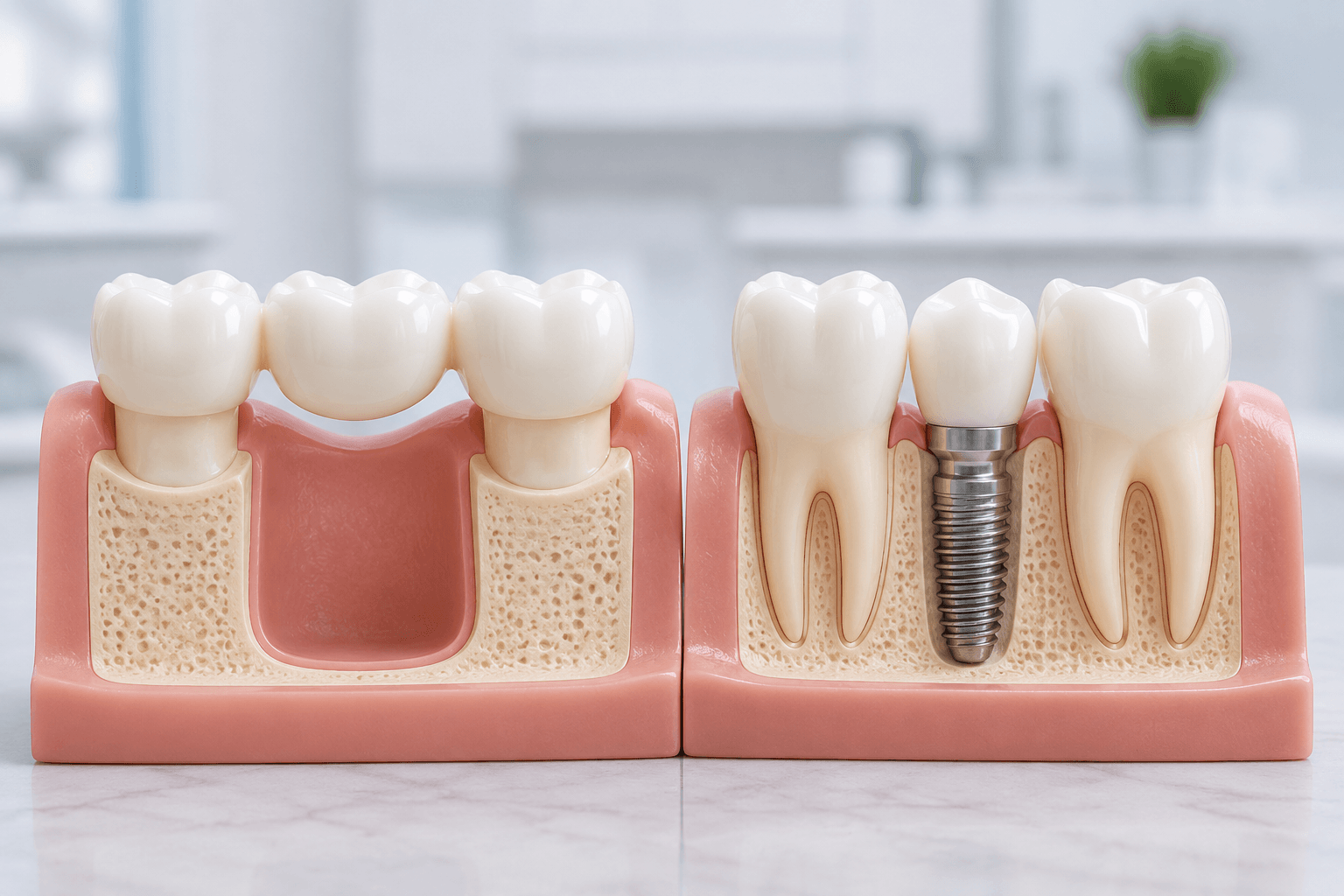
Losing a tooth can leave you wondering which replacement option makes the most sense. A dental bridge and a dental implant are both commonly used to replace a single missing tooth, but neither is automatically the right choice for everyone. The most appropriate option depends on factors such as the condition of the surrounding teeth and gums, your oral health, and the findings of a dental examination. Rather than focusing on which treatment is “better,” your dentist will help determine which option best fits your individual situation.
If you’re considering replacing a missing tooth in Nepean or the Ottawa area, understanding the differences between these treatments can help you feel more prepared before your appointment.
What Is the Difference Between a Dental Bridge and a Dental Implant?
Although both treatments replace a missing tooth, they do so in different ways.
A dental bridge fills the gap by attaching an artificial tooth to neighbouring teeth that provide support. Depending on the situation, those supporting teeth may need to be prepared so the bridge can fit securely. The replacement tooth sits between them, helping restore the appearance and function of your smile.
A dental implant replaces the missing tooth differently. Instead of relying on nearby teeth for support, an implant is placed within the jawbone and later fitted with a custom restoration. Because the two treatments work differently, your dentist will evaluate several aspects of your oral health before recommending one over the other.
Understanding this distinction is important because the choice isn’t simply about replacing the missing tooth. It’s also about choosing an approach that fits your overall oral health and long-term needs.
How a Dental Bridge Replaces a Missing Tooth
A dental bridge has been used for many years to replace one or more missing teeth. For many patients, it may be considered when the surrounding teeth are healthy enough to support the restoration and when it aligns with the individual’s treatment goals.
One advantage of a bridge is that it restores the visible gap without placing an implant into the jaw. Once completed, it may improve chewing ability, speech, and the overall appearance of the smile.
That said, a bridge isn’t automatically recommended whenever a tooth is missing. Your dentist will first examine the neighbouring teeth to determine whether they can adequately support the restoration. Existing restorations, decay, gum health, and the amount of remaining tooth structure can all influence the decision.
The location of the missing tooth also matters. A bridge that works well in one area of the mouth may not be the most appropriate solution in another. Every recommendation is based on the specific clinical findings rather than a standard approach.
Because every patient’s oral health is unique, treatment planning involves looking beyond the missing tooth itself. Your dentist considers how the replacement will function alongside your natural teeth and whether it is likely to meet your needs over time.
How a Dental Implant Replaces a Missing Tooth
Unlike a bridge, a dental implant replaces the missing tooth by supporting the restoration independently rather than attaching it to neighbouring teeth. For some patients, this may be an appropriate option depending on the health of the jawbone, gums, and surrounding structures.
If your dentist determines that an implant may be suitable, they may discuss dental implants as one possible way to replace the missing tooth. The conversation focuses on whether an implant fits your individual circumstances rather than assuming it is the preferred treatment for everyone.
Several factors influence this decision. Your dentist may assess:
- The condition of your gums.
- The amount of available bone.
- The location of the missing tooth.
- Your overall oral health.
- Your medical history and personal treatment goals.
These factors help determine whether an implant is likely to be appropriate or whether another option may better suit your needs.
An implant should not automatically be viewed as the “better” solution simply because it is different from a bridge. Likewise, choosing a bridge does not necessarily mean you’re receiving an inferior treatment. Both options have situations where they may be appropriate, and the right recommendation depends on a careful clinical assessment rather than a general rule.
For many people, comparing these treatments becomes much easier after speaking with a dentist who can explain how each option relates to their own smile rather than discussing tooth replacement in general.
Factors a Dentist May Consider When Comparing a Bridge and Implant
Although a bridge and an implant can both replace a single missing tooth, the decision is rarely based on one factor alone. Your dentist will consider your overall oral health before discussing which option may be appropriate.
Some of the factors that may be evaluated include:
- The health of the teeth beside the gap.
- The condition of your gums.
- The amount of available jawbone.
- The location of the missing tooth.
- Your bite and how your teeth come together.
- Existing dental restorations or previous treatment.
- Your overall medical history and treatment goals.
It’s also important to remember that treatment planning isn’t based on a single X-ray or one characteristic of the missing tooth. Your dentist looks at how your entire smile functions. The amount of available space, the condition of nearby teeth, the health of the surrounding tissues, and the way your teeth come together can all influence the recommendation. Two patients with a missing tooth in the same location may receive different advice because their oral health is different.
Your dentist may also consider how the surrounding teeth are expected to function over time. If neighbouring teeth already have large restorations or existing concerns, that information becomes part of the overall assessment. Likewise, healthy gums and good oral hygiene habits play an important role in supporting any type of tooth replacement. Looking at the complete picture allows your dentist to recommend an option that fits your current oral health rather than focusing only on the missing tooth itself.
Personal preferences can also be part of the conversation. Some people want to understand how each option fits into their daily routine, while others are more focused on preserving neighbouring teeth or learning what ongoing care may involve. These discussions don’t determine treatment by themselves, but they help your dentist recommend an option that suits both your oral health and your goals.
Rather than asking which treatment is generally “better,” it’s more helpful to ask which one best fits your individual circumstances. An assessment allows your dentist to explain the reasons behind a recommendation, answer your questions, and discuss the advantages and limitations of each option based on your specific needs. This personalized discussion often gives patients greater confidence when deciding how they would like to move forward.
If you’re already attending regular family dentistry services appointments, discussing a missing tooth early may help you understand your options before other changes occur in your oral health.
Frequently Asked Questions About Dental Bridges and Implants
Is a dental implant always better than a bridge?
No. Neither treatment is automatically better for every patient. Both bridges and implants can successfully replace a missing tooth, but the most appropriate recommendation depends on factors such as your oral health, the condition of neighbouring teeth, your jawbone, and your treatment goals.
Can a dental bridge replace a single missing tooth?
Yes. Dental bridges are commonly used to replace a single missing tooth when the surrounding teeth are healthy enough to support the restoration. Before recommending a bridge, your dentist will evaluate those teeth, along with your gums and bite, to determine whether it is an appropriate choice for your specific circumstances.
How long do dental bridges and implants last?
Both bridges and implants are intended to be long-term tooth replacement options, but there is no single lifespan that applies to everyone. Their longevity depends on factors such as oral hygiene, regular dental visits, everyday wear, and overall oral health.
Talk to Dr. Valerie Archibald & Associates About Tooth Replacement Options
Choosing between a bridge and an implant doesn’t have to feel overwhelming. While both treatments replace missing teeth, the most appropriate option depends on your oral health, the condition of the surrounding teeth, and what is identified during a professional assessment.
If you’re considering tooth replacement in Nepean or the Ottawa area, you can book an assessment with Dr. Valerie Archibald & Associates. During your visit, your dentist can evaluate your smile, answer your questions, and discuss tooth replacement options that align with your individual oral health needs and treatment goals.