
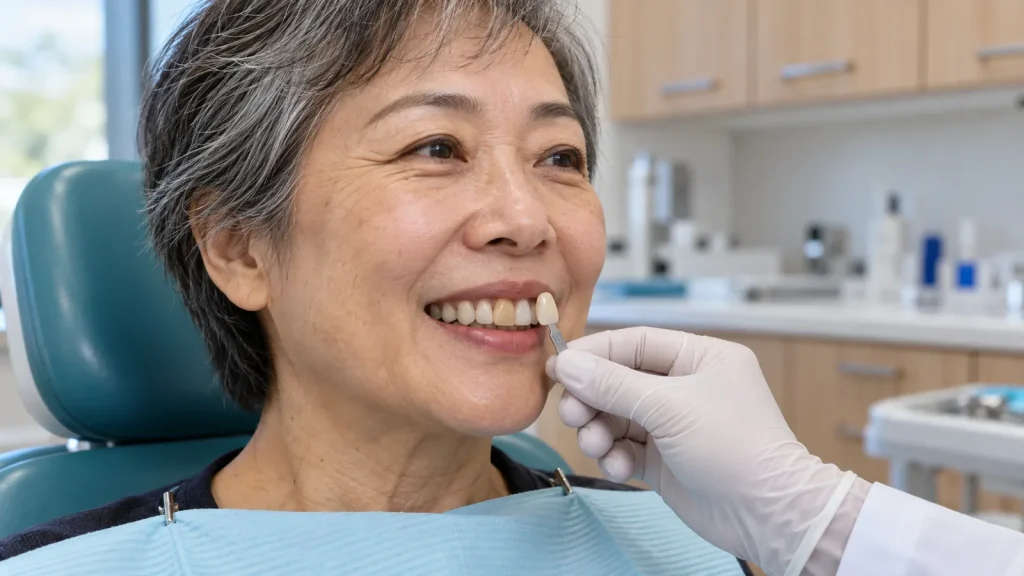
One front tooth can look darker because of surface stain, an existing filling or crown, or a change within the tooth. An old injury may also be relevant. The colour alone cannot establish the cause, so the first step is an assessment before whitening the tooth or covering it.
It is understandable to focus on appearance when the tooth is visible every time you smile. A cosmetic dentist also needs to establish whether it is healthy and structurally sound. Those findings determine which options are appropriate and whether anything needs treatment first.
Dr. Valerie Archibald & Associates provides cosmetic dentistry in Nepean, Ottawa. If one tooth has changed shade, describe that specific concern when arranging a visit rather than assuming you need a general whitening appointment.
Why one tooth can look different from its neighbours
Natural teeth are not necessarily identical in colour. However, a new or noticeable difference in one tooth deserves a closer look, especially if it follows an injury or appears around existing dental work.
Try to describe where the difference is. Does the whole tooth look darker, or only an area near an old filling? Is the colour concentrated at the gumline? Has the tooth also changed shape or developed a rough edge? These observations can help you explain the concern without having to identify its cause.
The moment you notice a difference may not be the moment it began. A photograph, different lighting or seeing your smile on a screen can draw attention to something that was less obvious before. If you have an older clear photograph, you can bring it, but camera settings and shadows make photographs imperfect comparisons.
Avoid repeated home experiments to see whether the shade will change. Trying stronger products or scrubbing one tooth harder does not answer the underlying question. Note what you have already used and whether it caused sensitivity, then bring that information to the visit.
Surface stain versus a change inside the tooth
Staining on the outer surface and colour coming from within the tooth need different consideration. A professional assessment can help distinguish them and determine whether existing restorative material contributes to what you see.
The American Dental Association’s whitening information explains that whitening does not work equally for every type of discolouration. Fillings, crowns and veneers do not bleach like natural teeth. If the darker area is a restoration, whitening nearby enamel may not resolve the contrast.
That distinction matters when one front tooth is the concern. A product designed to brighten the smile generally is not automatically a way to bring one tooth into line with the others. Ask what tissue or material is actually responsible for the colour difference.
Do not scrape the tooth, use acidic household mixtures or keep extending a whitening course to chase a result. Tell the dentist if the tooth has previously been whitened or repaired. Understanding that history is more useful than comparing the strength of another product before the cause has been established.
Why past injury and symptoms matter
A front tooth may have a history you have not thought about for years. Mention a childhood fall, a sports collision or a blow to the mouth, even if the tooth never visibly broke. The dentist can decide how that history relates to its current condition.
The American Association of Endodontists’ root canal guidance explains how the tissue inside a tooth can be affected by injury and other problems. This is one reason a colour assessment may include tests beyond looking at the shade. It does not mean every dark tooth needs a root canal.
Tell the team about sensitivity, pain on biting, swelling, a gum bump or a bad taste. If there are no symptoms, say that too. A painless tooth can still need evaluation, and colour alone is not proof of pulp death or infection.
An injury with a visible chip adds another issue to assess. The practice’s guide to assessment after tooth damage offers background on that situation. Do not assume that every dark tooth was chipped, or that repairing a chip alone will necessarily correct the colour.
Seek prompt dental advice for increasing pain, swelling or fever. Difficulty breathing or swallowing requires emergency medical help. These symptoms should take priority over a planned cosmetic consultation.
What a dentist checks before cosmetic treatment
The dentist considers the history, examines the tooth and surrounding tissues and checks existing restorations. Tests or imaging may be indicated to investigate the condition inside or around the tooth. Ask what the findings establish and whether anything needs further assessment.
It helps to separate the health question from the colour question. Is there a problem that needs treatment? Once that has been addressed or ruled out, what options could improve the appearance? The answers may involve different stages.
Dr. Valerie Archibald & Associates lists whitening, bonding and veneers among its cosmetic dentistry options in Nepean. Their suitability for a single dark tooth depends on the assessment, including any existing treatment and the condition of the remaining tooth.
Explain what you want to keep as well as what you want to change. Perhaps you like the shade of the surrounding teeth and simply want this one to attract less attention. Or you may be considering whitening the rest of your smile. Those goals can lead to different planning discussions.
Ask the dentist to explain the recommendation using the area of concern. Seeing which part is natural tooth and which part is a restoration can make the choices easier to understand.
How treatment choices depend on the cause
Some external staining may be addressed with professional cleaning. Whitening may be considered for suitable discolouration in natural tooth structure. A restoration that differs in shade requires its own assessment, including whether it is sound and whether replacement is justified.
For selected teeth that have already had root canal treatment, a clinician may discuss internal bleaching after evaluating the existing treatment and tooth. This is a specific professional procedure, not a reason to put ordinary whitening products inside a tooth. Ask about suitability, limitations and risks if it is proposed.
Bonding or a veneer may be an option for masking colour in some circumstances. A crown may be discussed when there are broader restorative needs. The choice should account for how much healthy tooth structure is present and what preparation would be involved, as well as the desired appearance.
The practice’s guide to dental veneers provides further background. A veneer is not a treatment for an underlying infection, and a colour change should not be covered without appropriate assessment first.
Ask about the most conservative suitable options and the trade-offs of each. No approach should be described as a guaranteed permanent colour match. Understand what can reasonably be achieved, how the result will be reviewed and what maintenance might be needed.
Questions to ask about matching the surrounding teeth
Matching one visible tooth involves the teeth beside it, not just a shade chosen in isolation. If you are considering other cosmetic changes, discuss them before finalizing the plan for the dark tooth.
Bring questions such as:
- Is the colour coming from the natural tooth, a restoration or both?
- Is there any health problem to address before changing the appearance?
- What suitable options preserve the most natural tooth structure?
- Would whitening other teeth change the order of treatment?
- What shade limitations should I expect?
- How will we review the appearance before treatment is completed?
- What future maintenance or repairs might be needed?
- What does the estimate include?
Be clear about timing, particularly if an event prompted the appointment. Ask what is realistic rather than letting a deadline decide the procedure. Some steps may depend on assessment, healing or the sequence of other planned care.
You can also ask what would happen if you chose no cosmetic change after the health assessment. Understanding that option helps you distinguish necessary care from an elective appearance decision.
Frequently Asked Questions
Can a tooth darken long after an injury?
An old injury can be relevant, so mention it even if it happened years ago. The dentist still needs to investigate the current condition. A remembered injury and a dark tooth do not, by themselves, establish the diagnosis.
Does a dark tooth always need a root canal?
No. Root canal treatment is based on the condition of the tooth and clinical findings, not colour alone. Ask what the assessment shows and whether any further tests are needed before a recommendation is made.
Will whitening strips treat every kind of discolouration?
No. Different causes respond differently, and restorative materials do not whiten like natural tooth structure. Find out what is causing the single-tooth difference before repeating a whitening course or trying a stronger product.
Can a filling or crown affect colour?
Yes. An existing restoration can contribute to a mismatch or become more noticeable over time. The dentist can assess both its appearance and condition. A shade concern does not automatically mean the restoration must be replaced.
Should a painless colour change be checked?
Yes. Lack of pain does not explain the colour change. Arrange an assessment and describe when you noticed it, any injury and past treatment. Report new pain, swelling or other symptoms promptly if they appear before the visit.
Discuss Your Questions With Dr. Valerie Archibald
For a front tooth that looks darker than its neighbours, contact Dr. Valerie Archibald & Associates in Nepean, Ottawa. Bring the history you know and explain the change you would like to see. Understanding the cause comes first; suitable cosmetic choices can then be discussed with clearer expectations.